
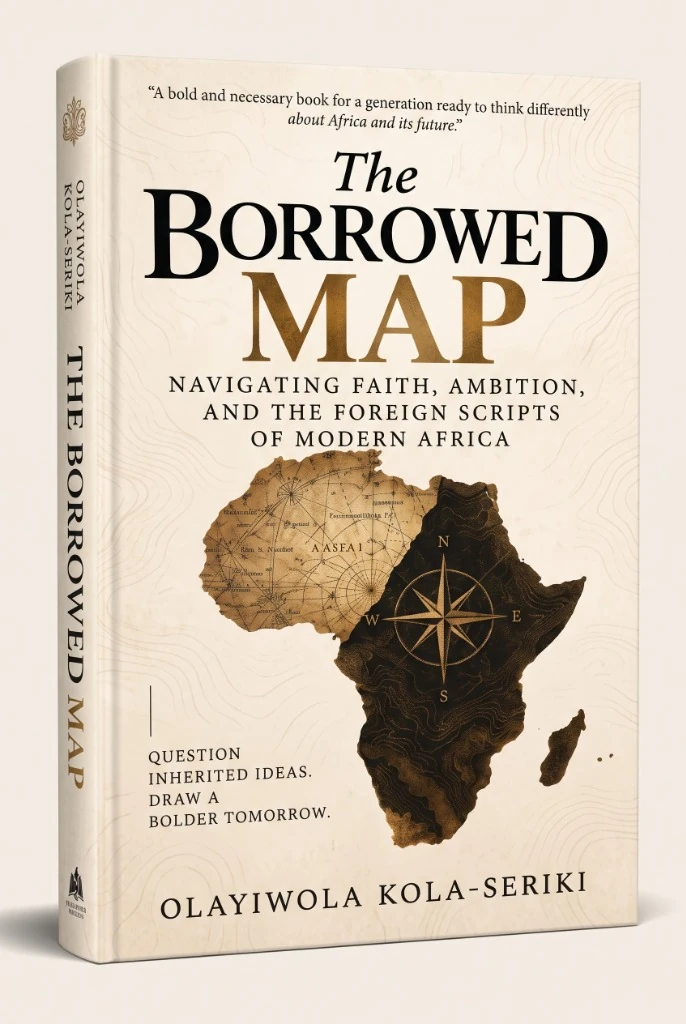
The Borrowed Map
Navigating Faith, Ambition, and the Foreign Scripts of Modern Africa
For generations, the roadmap of African ambition has been shaped by foreign contours—from colonial administrative curricula to Western corporate archetypes and imported religious systems.
In The Borrowed Map, Olayiwola Kola-Seriki traces the profound disorientation that occurs when external validation becomes the sole barometer of personal and societal progress, laying out a rigorous call to rediscover our own coordinates.
“The map you inherited is not the territory. Draw your own.”
The Central Question
“Whose map are you holding?”
When I was four years old in Western Nigeria, my family called me “Doctor Layi.” I had never seen an operating theatre, but I understood the unspoken code: give the answer that appeals to the community. Three decades later, I had followed an inherited syllabus to impressive effect—an accounting degree, an MBA, CITN Fellowship, ANAN qualifications, and an executive seat as Chief Financial Officer in Nigeria’s indigenous fintech sector.
Yet at Charles de Gaulle Airport, confronted with the familiar discomfort of being African at a European border, I found myself asking a question I could no longer ignore: had I built a life of my own, or simply become very good at following a map someone else had drawn?
The Borrowed Map examines how modern African societies quietly train us to distrust our own judgment. It traces the habits formed in childhood—the wooden vernacular token used to shame students caught speaking their mother tongue, and a culture of elder deference prizing silence over inquiry. Under economic strain, the pressure to conform intensified: as institutions decayed, families pursued credentialism and religious promises of sudden breakthrough, seeking escape rather than building structural competence.
We surrendered our personal compasses to a narrow, anxious triad: Doctor, Lawyer, or Japa. We treated emigration as our only salvation and carried the heavy burden of Black Tax, assuming the next stamp in an expatriate passport would resolve our displacement.
Part memoir, part cultural critique, and part leadership reflection, The Borrowed Map refuses simplistic slogans. Moving from schoolyards to executive boardrooms, and ending on an Osogbo ridge where a surveyor’s drone maps ancestral soil under my daughter Simi’s gaze, this book asks the defining question for modern Africa: when inherited maps lead us into systemic drift, do we finally have the courage to draw our own?
Who Should Read This Book?
The Borrowed Map is written for African professionals, entrepreneurs, students, policymakers, members of the diaspora and anyone questioning inherited definitions of achievement, faith, identity and progress.
Full Architecture · 4 Parts · 12 Chapters
Inside The Borrowed Map
4 Parts · 12 Chapters · Prologue & Epilogue
The Script
Examining the inherited cultural, generational, and religious conditioning that silently programs our earliest notions of obedience and success.
- Ch. 1: The Invisible Software
- Ch. 2: The Altar of the Elder
- Ch. 3: Imported Gods
The Map
Interrogating the societal blueprints and spiritual coping mechanisms we construct when institutional structures fail us.
- Ch. 4: The Architecture of Hope
- Ch. 5: Superstition as a Sedative
- Ch. 6: The Wisdom of Paradox
The Prize
Deconstructing the relentless pursuit of external status, emigration pressures, and the heavy familial obligations of the African professional.
- Ch. 7: The Holy Trinity of Ambition
- Ch. 8: The Weight of the Village
- Ch. 9: The Anatomy of True Value
The Compass
Reclaiming intellectual sovereignty, institutional endurance, and personal agency to chart an authentic trajectory forward.
- Ch. 10: The Discipline of Doubt
- Ch. 11: The Architecture of Institutions
- Ch. 12: Drawing Our Own Map
Author's Perspective
Why I Wrote The Borrowed Map
I wrote this book because I watched some of the most gifted minds of my generation achieve everything our parents, schools, and foreign institutions demanded of them—only to arrive at a profound spiritual exhaustion.
We had mastered the curricula. We had learned to translate our ideas into the acceptable vocabularies of Western boardrooms, think tanks, and academic faculties. But in doing so, we had silently accepted an unspoken premise: that to become significant, we had to leave ourselves behind.
The Borrowed Map is not an exercise in bitterness or isolationism. It is a work of gratitude for the journey, coupled with the courage to say: the map we were handed is insufficient for where we must go next. It is written for anyone who has ever felt the silent dislocation of succeeding in a system that was never designed with their spiritual and cultural flourishing in mind.

Olayiwola “Layi” Kola-Seriki
About the Author
Olayiwola “Layi” Kola-Seriki (Kola-Seriki Quddus Olayiwola) is a Chief Financial Officer in Nigeria’s indigenous fintech sector, Founding Partner at OAC Tax & Accounting, Fellow of the Chartered Institute of Taxation of Nigeria (CITN / FCTI), Fellow Certified Management Consultant (IMC / FCMC), Associate Member of the Association of National Accountants of Nigeria (ANAN / CNA), and alumnus of Fountain University, Osogbo.
Rather than writing from an ivory tower, Layi examines post-colonial conditioning, faith, and generational ambition as an active corporate insider auditing the very machinery of modern prestige that shaped his career across fintech, taxation, and enterprise directorships.
Read Full Biography →Editions & Purchasing
Publication Details
Professional editorial review, interior design, and international distribution.
4 Parts · 12 Chapters · Prologue & Epilogue
National Library of Nigeria · Trade Paperback Edition
Edition & ISBN Architecture
In compliance with National Library of Nigeria statutory cataloging standards, each separate physical and digital format is assigned its own distinct ISBN upon final production clearance.
| Edition / Format | ISBN Status | Distribution & Availability |
|---|---|---|
| Trade Paperback | 978-978-67-2452-2 | Assigned trade ISBN · Global distribution via Amazon, Bookshop.org & booksellers |
| Hardcover | To be confirmed | Library and commemorative cloth-bound edition |
| eBook | To be confirmed | Digital EPUB / Kindle edition across global platforms |
| Audiobook | To be confirmed | Unabridged author narration accompanying trade release |
Purchase & Pre-order Links
Pre-orders will go live upon official announcement. Join the waitlist below to receive immediate notification and exclusive first-run pricing.
Get Notified on Pre-Order LaunchAdvance Reader Access
Interested in reading The Borrowed Map before publication?
A limited number of Advance Reader Copies will be made available to selected early readers, reviewers, and cultural commentators.
Publishing & Production
The Borrowed Map will be independently published under Coordinates Press, the author's publishing imprint. The production programme includes professional editorial review, interior design, cover development and international distribution planning.